The Institut Català de Nanotecnologia (ICN - www.nanocat.org) was born in July 2003. It is a centre participated by three institutions: the Catalan Ministry of Universities, the Universitat Autònoma de Barcelona (UAB) and the Consejo Superior de Investigaciones Cientificas (CSIC). The institute is born to put in close contact scientists of different disciplines that traditionally work in separated areas (buildings and institutions). Therefore, it has been specially designed to host interdisciplinary research projects as the one I am proposing. Also, scientist are coming from other parts of Spain and Europe (Switzerland, France, Germany…). Up to now, the ICN counts with four main departments: a) Modelization, simulation, imaging and atomic and molecular manipulation; b) Synthesis and functionalization of nanostructures; c) Physical properties of nanostructures; d) Nanobiology.
As a part of the Campus of the UAB, scientist at the ICN have access to all the experimental capabilities from different scientific research centres like the Institut de Ciència de Materials (ICMAB)1, the Serveis Científico Tècnics of the UAB2 and the Centre Nacional de Microelectrònica (IMB-CNM) 3. In addition of the expertise that exist at the scientific pole of the UAB I will benefit from the new nearby synchrotron light source ALBA4. Besides, 9 millions of euros are planned to be invested in the next 3 years for the acquisition of new equipment, such as an Scanning Transmission Electron Microscope with energy analysis, XRD machine (GADDS 8 detector – type), atmospheric SEM, beam writer or an He liquefier. The total number of scientific researchers will be of the order of 200, and the expected number of research units rise up to 25-30. At present 12 research units have been approved.
I have been proposed to lead one of these units for the study and production of engineered nanoparticles and develop technologies based on them. This gives me an excellent opportunity to lead a new group in an exciting environment and with very interesting financial supports.
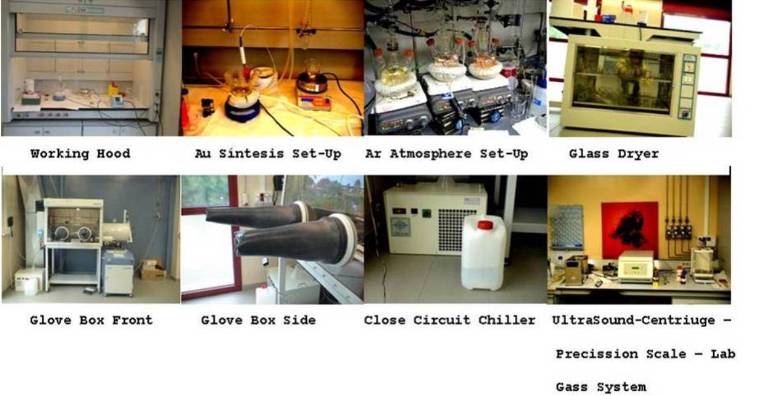
Nowadays I have a laboratory which is fully equipped for the synthesis and conjugation of nanoparticles, with all the characterization techniques available in-campus (or in the same building). Therefore I have the glass set-up for aerobic or anaerobic (schlenk) synthesis of nanoparticles, and the support equipment to deal with wet synthesis (vortex, stirrer, T-controller, dryer, cleaning baths, heating mantles…), I have a Glove Box – mBraum Unilab - equipped with Pt and Cu catalysers, an organic solvent trap and refrigerator (-42 ºC), what allows to prepare the precursors solutions in dry conditions (less then 1 ppm of O2 and H2O) and to keep them stable. Also small equipment as centrifuge (16.000 rpm), precision scale, ultra-sounds bath, etcetera. I also have the equipment for conjugation (thermal bath), purification (dialysis) and characterization-isolation of conjugates (electrophoresis gels). There is a service of Cell Cultures at the UAB which gives you the needed support for your in-vitro studies. I have common projects with them.
In addition I have the complete support from the institute direction to develop such a projects based on nanoparticles conjugates and an excellent administrative support what allows me to concentrate in the scientific issues of the project.