
Design, preparation and characterization of nanomaterials for sensors and biosensors applications

Quantum Dots with electrochemical properties as well as other nanoparticles with special interest for biosensor applications have been developing. Different methods of synthesis for the production of electroactive nanocrystals (NCs) for use as labels in bioensing systems are being used. They are based on two general ways of controlling the formation and growth of the nanoparticles: (a) physical restriction of the volume available for the growth of the individual nanoparticles by using templates such as reverse micelles; (b) arrested precipitation that depends on exhaustion of one of the reactants. Simple strategies for producing silver and gold nanoparticles (AgNP and AuNP) along with the corresponding core shell nanoparticles (Au–Ag and Ag–Au) by reduction of the metal salts are also used.
The obtained NPs are characterized by transmission electronic microscopy (TEM), UV–Vis absorption spectroscopy as well as electrochemical methods so as to see their future applications in sensing and biosensing including DNA sensors and immunosensors.
Alternative detections of nanoparticles with interest for future applications in biosensing systems are being studied too. ICP-MS, for example, offers great opportunities for such applications.
Read more at:
- “Direct voltammetric determination of gold nanoparticles using graphite-epoxy composite electrode”, Electrochimica Acta, 50, p. 3702–3707 (2005)
- “Crystal and electrochemical properties of water dispersed CdS nanocrystals obtained via reverse micelles and arrested precipitation”, Nanotechnology, 17, p. 2553–2559 (2006)
- “Detection of cadmium sulphide nanoparticles by using screen-printed electrodes and a handheld device”. Nanotechnology, 18 (2007) (Published on-line).
- “Silver, gold and the corresponding core shell nanoparticles for sensing applications”. Journal of Nanoparticle Research, 10, p. 97–106 (2008)
- “ICP-MS - a powerful technique for quantitative determination of gold nanoparticles without previous dissolving" Journal of Nanoparticle Research, 11, p. 2003 (2009)
Electrochemical sensors based on nanostructurated materials (i.e. carbon nanotubes etc.) for environmental monitoring and other industrial applications

Study of the ability of nanomaterials (i.e. carbon nanotubes, nanoparticles etc.) to be immobilized onto several electrodic transducing platforms so as to generate a high-conductive surface area interface that enables the sensitive / catalytic detection of ionic, molecular and biomolecular analytes.
We are interested in developing materials that structurally, chemically and mechanically mimic the biological molecules (i.e. enzyme, antibody) they have to replace or assists.
Many nanomaterials, especially carbon nanotubes (CNTs) and metal nanoparticles, have excellent catalytic properties. The introduction of CNT and nanoparticles with catalytic properties into electrochemical sensors and biosensors decrease overpotentials of many analytically important electrochemical reactions, and even realize the reversibility of some redox reactions, which are irreversible at common unmodified electrodes. Novel applications in biosensors for biomedical and industrial applications can be expected.
This activity aims at improving the performance (sensitivity, selectivity, response range etc.) for various kinds of biosensors with special interest in applications in food industry as well as clinical analysis.
Read more at:
- “New materials for electrochemical sensing VI. Carbon nanotubes”, Trends in Analytical Chemistry, 24, p. 826-838 (2005)
- “Glucose Biosensor Based on Carbon Nanotube Epoxy Composites”, Journal of Nanoscience and Nanotechnology, 5, p. 1694–1698 (2005)
- “Carbon nanotube-epoxy composites for electrochemical sensing” Sensors & Actuators B, 113, p. 617–622 (2006)
- “Carbon nanotube detectors for microchip CE: Comparative study of single-wall and multiwall carbon nanotube, and graphite powder films on glassy carbon, gold, and platinum electrode surfaces”, Electrophoresis, 28, p. 1274–1280 (2007)
- “Carbon nanofiber vs. carbon microparticles as modifiers of glassy carbon and gold electrodes applied in electrochemical sensing of NADH”, Talanta, 74, p. 398–404 (2007)
- “A Carbon Nanotube PVC Based Matrix Modified with Glutaraldehyde Suitable for Biosensor Applications”. Electroanalysis, 20, p. 603 – 610 (2008)
- “Enhanced host-guest electrochemical recognition of dopamine using cyclodextrin in the presence of carbon nanotubes”, Carbon, 46, p. 898-906 (2008)
- “Improvement of the electrochemical detection of catechol by the use of a carbon nanotube based biosensor”, Analyst, 134, p. 60 (2009)
Nanoparticle based electrochemical detection (bio)systems and biosensors for DNA, protein and cell detection with interest for user-friendly diagnostics, security and quality control for various applications

The DNA sensors and immunosensors are playing a growing role in various fields where an accurate, low cost, fast and on-line measuring system is required. To improve the electrochemical assay sensitivity and to achieve at better and more reliable analysis there is a great demand for labels with higher specific activity. The most used labels for electrochemical sensors up to date have been enzymes as well as small molecules like electroactive indicators (dyes, etc.). In principle nanoparticles provide a novel platform for improving specific activity of a label as well as affinity to the tracer molecules (DNA probes or other biomolecules). Nanosized particles have a chemical behaviour similar to small molecules and can be used as specific electrochemical labels. Nanoparticles in general and quantum dots (QDs) particularly, may be expected to be superior in several ways. Compared to existing labels, nanoparticles in general and QDs especially, are more stable and cheaper. They allow more flexibility, faster binding kinetics (similar to those in a homogeneous solution), high sensitivity and high-reaction rates for many types of multiplexed assays, ranging from immunoassays to DNA analysis.
The developed biosensors will be applied, in collaboration with other specialized laboratories, for example in genetic screening for cystic fibrosis or other similar cases. Binding nanoparticles to a specific antibody for cancer cells could make cancer detection much easier. Based on these ideas specific optical & electrochemical biosensors are being designed.
Read more at:
- “New materials for electrochemical sensing. V. Nanoparticles for DNA labelling”, Trends in Analytical Chemistry, 24, p. 341-349 (2005)
- “Toward an ICPMS-linked DNA assay based on gold nanoparticles immunoconnected through peptide sequences”, Analytical Chemistry, 77, p. 6500-6503 (2005)
- “Magnetically trigged direct electrochemical detection of DNA hybridization based Au67 Quantum Dot – DNA – paramagnetic bead conjugate”, Langmuir, 21, p. 9625-9629 (2005)
- “Electrochemical genosensors for biomedical applications based on gold nanoparticles”, Biosensors and Bioelectronics, 22, p. 1961–1967 (2007)
- “Double-codified gold nanolabels for enhanced immunoanalysis”, Analytical Chemistry, 79, p. 5232-5240 (2007)
- “Direct electrochemical stripping detection of cystic fibrosis related DNA linked through cadmium sulphide quantum dots”, Nanotechnology 20, 055101 (6pp) doi:10.1088/0957-4484/20/5/055101. (on-line publication) (2009)
- “Rapid identification of tumour cells using a novel electrocatalytic method based in gold nanoparticles”, Analytical Chemistry, 81, p. 10268-10274 (2009)
- “Controlling the electrochemical deposition of silver onto gold nanoparticles: Reducing interferences and increasing the sensitivity of magnetoimmuno assays”, Biosensors & Bioelectronics 24 p. 2475–2482 (2009)
- “Enhanced Gold Nanoparticle based ELISA for Breast Cancer Biomarker”, Analytical Chemistry 82, p.1151–1156 (2010)
- “Electrochemical detection of proteins using nanoparticles: applications to diagnostics”, Expert Opinion on Medical Diagnostics 4(1), p. 21-37 (2010)
Fast and low cost sensing devices for heavy metals and other compounds with interest for environment and other industrial applications
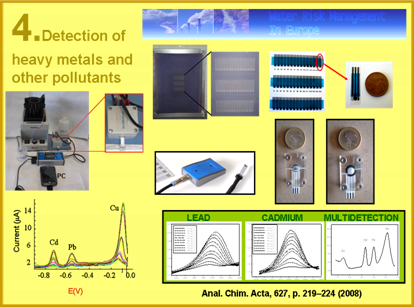
There is a great demand for determination of heavy metals, phenols and other pollutants in the environment. The detection techniques must accomplish a series of requisites like sensitivity, precision, accuracy, dynamic range, ease of pretreatment / sample preparation, ease of automation, cost, suitability for studies in the field, applicability to a wide range of substances, and the capability of determining more than one species. The general trend for more environmental friendly materials and the extreme toxicity of mercury (used so far to build electrodes for electrochemical stripping techniques) have led to a growing interest in the use of mercury free electrodes.
Manufacturing smaller-scale detection devices with an improved detection capability and based on free-mercury materials is the subject of this research. The idea is to apply these devices as a water monitoring tool so as to achieve an automatic control of heavy metal levels in sea, river, lakes, and wastewaters all over Europe. This work is being developed under the framework of the WARMER project (Water Risk Management in Europe). The WARMER project (http://www.projectwarmer.eu/) is a FP6 EU project that aims to create an extended system for on-line water monitoring with the main purpose of risk management.
The research in this field is based on the use of nanostructurated materials (i.e. nanoparticles, carbon nanotubes etc.) so as to achieve the required parameters for real applications.
Read more at:
- “Stripping voltammetry with bismuth modified graphite-epoxy composite electrodes”, Electroanalysis, 17, p. 881-886 (2005)
- “Sensitive stripping voltammetry of heavy metals by using a composite sensor based on a built-in bismuth precursor”, Analyst, 130, p. 971-976 (2005)
- “Determination of lead and cadmium in tap water and soils by stripping analysis using mercury-free graphite–epoxy composite electrodes”, Procedure 7 at Volume 49 “Electrochemical Sensor Analysis” Alegret and Merkoçi (Eds), Comprehensive Analytical Chemistry, Elsevier B.V., e47-52 (2007)
- “Sensitive and stable monitoring of lead and cadmium in seawater using screen-printed electrode and electrochemical stripping analysis”, Anal. Chim. Acta, 627, p. 219–224, (2008)
- “Surface Characterizations of Mercury Based Electrodes with the Resulting Micro and Nano Amalgam Wires and Spheres Formations May Reveal Both Gained Sensitivity and Faced Non-Stability in Heavy Metal Detection”, Journal of Physical Chemistry C 114, p. 9049-9055 (2010)
Lab-on-a-chip systems with interest for in-field screening of analytes and other applications
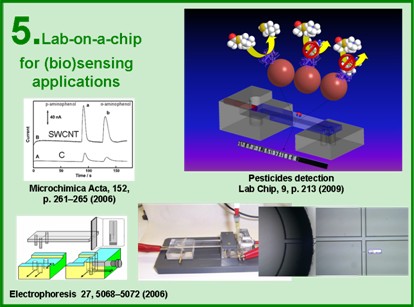
Lab-on-a-chip technology, based for example on capillary zone electrophoresis with electrochemical detection offers tremendous potential for obtaining desired analytical information in a simpler, faster and cheaper way compared to traditional batch/laboratory-based technology. It is particularly attractive for multiple DNA recognition applications (i.e. point-of-care) thanks to the high-throughput, automation, versatility, portability, reagent/sample economy and high-performance of such micromachined devices.
The research is this field aims to create and characterize portable bioanalytical systems where nanoparticles and carbon nanotubes, bringing special advantages, will be involved. The developed systems will be able to perform “point-of-care” analysis of analytes with interest in clinic, environment and food industry. The developed lab-on-a-chip devices hold special interest in space exploration and will be carried out in collaborations with specialized institutes. It represents also a novel analytical technology in the context of systems biology to a better understanding of health and disease and intervention strategies and will be developed in collaboration with other institutes.
Read more at:
- “New materials for electrochemical sensing VII. Chip microfluidic platforms” Trends in Analytical Chemistry, 25, p. 219-235 (2006)
- “Microchip Capillary Electrophoresis-Electrochemistry with Rigid Graphite-Epoxy Composite Detector”, Electroanalysis, 18, p. 207 – 210 (2006)
- “Microchip Capillary Electrophoresis with a Single-Wall Carbon Nanotube/Gold Electrochemical Detector for Determination of Aminophenols and Neurotransmiters”, Microchimica Acta, 152, p. 261–265 (2006)
-”Microchip electrophoresis with wall-jet electrochemical detector: Influence of detection potential upon resolution of solutes”, Electrophoresis, 27, p. 5068–5072 (2006)
- “Analysis of nitroaromatic explosives with microchip electrophoresis using a graphite–epoxy composite detector”, Procedure 49 at Volume 49 “Electrochemical Sensor Analysis”, Alegret and Merkoçi (Eds), Comprehensive Analytical Chemistry, Elsevier B.V., e351-355 (2007)
- “Lab-on-a-chip for ultrasensitive detection of carbofuran by enzymatic inhibition with replacement of enzyme using magnetic beads”, Lab Chip, 9, p. 213 (2009)